Thesis: Knowledge Management Using SpiCE (2016)
The concept of Knowledge Management (KM) has been continually evolving. Traditionally, KM has been perceived in two distinct yet widely accepted ways. One perspective emphasizes converting data into information and then into knowledge. Another prevalent viewpoint centers on enhancing capabilities through learning; it examines how KM facilitates both individual and collaborative learning, ultimately leading to personal or shared achievements.
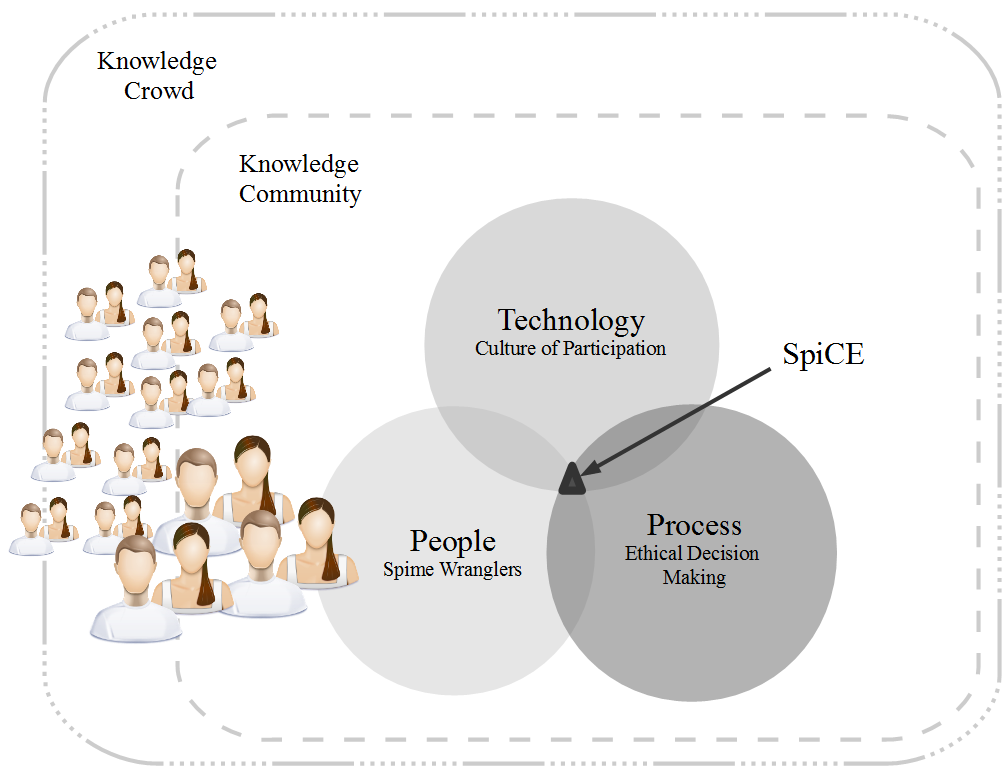
This is where SpiCE comes into play—a comprehensive KM framework that integrates these concepts. SpiCE derives its name from three key components: spime wrangling (inspired by Bruce Sterling), a culture of participation (aligned with Gerhard Fischer’s ideas), and ethical decision-making (as conceptualized by Ben Mepham and William McDonough).
Within SpiCE, spime wrangling is used to describe the exploration of data and information. A culture of participation is integral to SpiCE, encompassing interactive domains where individual and collective learning and knowledge creation unfold through the exploration of data and information.
To guide the development of sustainable outcomes, SpiCE integrates theories and concepts from ethical decision-making. By doing so, SpiCE navigates the intricate interplay among individuals, processes, and technology to foster decision-making outcomes that stand the test of time.