Category: Interesting media

  • Interesting media for August 2026 revisited (Carlson & Biden interview).

    I quite enjoyed this interview by Tucker Carlson (who I next to never agree with on anything) and Hunter Biden (who I really didn’t know anything about, except for some laptop (??) …which they discuss). I found interesting conversation points from both folks.

    Now, it is a beefy one (2+ hours), but, again, well worth your time. The conversation weaves through social media, AI, politics, addiction, life, and beyond.

    -tMac

  • Interesting Media for July/August 2026 (& a bit of a life update)

    July, well, May and June too, have been very trying months for me and my family. On May 18th, my beautiful mom passed away. She will be deeply missed. I’m very grateful to my wife Nova (& doggo Pippin) and sooooo much to all my siblings: my older sister Krista, younger sister Tess, and younger brother Joey, all of whom have helped our family through this time so very much. Family really is the most important thing in this life. I really feel for my Dad. My parents were married over 50 years and made such a wonderful home for my siblings and me. We’re all helping him through this time, as well as each other. Again, so very grateful to all! ❤️

    Here’s me and my mom from WAY back when. She really was the rock of our family. She’ll be in my heart forever.❤️❤️❤️❤️❤️

    So ya, back to this post. I really want to try to be consistent with my promise of sharing a few things I’ve found interesting each month. Given the business of summer and the fact that August will entail a lot of prep time for the upcoming Fall term, I’m combining these two months, even if just for my own mental capacity.

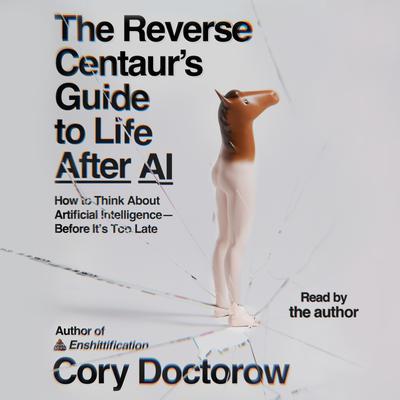
    I did come across several interesting media items. However, two have really stood out. One–an article by my colleague, Dr. Alec Couros (Faculty of Education at the University of Regina), titled “Tips Up or Tips Down, Revisited,” and, two–a book by Cory Doctorow titled “The Reverse Centaur’s Guide to Life After AI: How to Think About Artificial Intelligence—Before It’s Too Late.”

    By Enzik – Own work, CC BY-SA 3.0, https://commons.wikimedia.org/w/index.php?curid=1629308

    Let’s start with Alec’s Substack post, Tips Up or Tips Down, Revisited. In his post, Alec shares a 2012 story where his five-year-old son asked if bananas grow with tips up or down. Instead of encouraging curiosity, Alec quickly looked up the answer on his phone. They soon confirmed bananas grow with tips up, but Alec later recognized he missed an opportunity to nurture his son’s curiosity, imagination, and reasoning.

    His concern wasn’t about technology per se, but about what happens when answers come too quickly, before people have a chance to think deeply.

    Alec thinks this issue is more critical now with the growth of generative AI. While search engines make users search through info and form their own conclusions, AI gives quick, polished answers and even proposes follow-up questions. Alec worries that this technology might do more than just answer questions; it could also hinder our ability to create our own questions and ideas. I share this concern.

    Alec isn’t opposed to AI, and I share his view, even if I sometimes sound critical about it during conversations. We both use it regularly and recognize its value. However, Alec stresses the importance of sequence: people should think, wonder, and reason first before consulting AI. I just so happen to agree with this process/approach.

    This article caught my attention because, in my professional experience, I see myself as a teacher. I agree with Alec’s view that educators should foster classroom spaces where students talk, reflect, and justify their ideas prior to using AI or digital tools. AI should serve as a thinking partner, not a substitute. However, I’m uncertain how educators will achieve this, given that our control over the learning environment has diminished—being limited by time and the accessibility and control of the technologies students use.

    While teachers have traditionally fostered critical thinking by rewarding reasoning, encouraging students to deeply engage with ideas, teaching how to verify information, and demonstrating curiosity— you know, the approach in the pre-GenAI world relied on these methods. Now, I’m wondering how we can return to this foundational approach—although I do have some ideas, and perhaps innovative UI/UX designs and supporting technologies can make a difference… more on that later!

    Suffice it to say, as I believe Alec alluded to, learning happens in the space between questions and answers, and that space is worth protecting. How we protect it…well, it’s something I want to delve more into over the next little bit.

    I’ve chosen Cory’s book, “The Reverse Centaur’s Guide to Life After AI,” as my next interesting media thingy.

    In it, Cory explores how AI is changing our work and society, often in ways different from what many tech companies suggest. He introduces two concepts: a “centaur,” a person who leverages technology to enhance their abilities by merging human skills with tech support; and a “reverse centaur,” whose work is dictated by technology, often forcing them to work at unrealistic, draining speeds. Examples include delivery drivers monitored by algorithms, warehouse workers pushed to impossible targets, and programmers expected to do more than is feasible. I really love these metaphors.

    Now, Cory isn’t against AI, despite what many critics believe. Like Alec (in the above post) and me, he sees AI tools as innovative and valuable when used responsibly. His primary concern isn’t the technology itself, but how it’s marketed and adopted. He mentions that AI has been hyped up, pushed by a tech industry eager to attract investors by claiming AI will revolutionize the world and generate substantial profits. Yet, many real-world AI implementations haven’t met these lofty expectations.

    The book points out that AI is frequently seen as an unstoppable force of change, regardless of whether the stories are optimistic or alarming. Cory urges us to see beyond the hype, question who actually benefits from AI, and consider who might be paying the costs. In the end, he promotes the centaur metaphor–a future where AI aids people and enhances their lives, rather than overburdening workers or reducing human control over work.

    Now, who can argue with this? In my opinion, this is a must-read (or must-listen – the audiobook is narrated by Cory himself!) for not only software engineers and computer scientists but for everyone!

    -tMac

  • Interesting Media for June 2026

    In an attempt to reduce my reliance on social media apps (e.g., LinkedIn, Facebook, Instagram) and their pesky attempts to easily scrape all data for their AI bullshit systems, I’ve decided to try blogging more. I acknowledge this won’t stop the tech oligarchs from stealing my data. However, it makes me feel better that they might need to do a little more to get it (maybe?).

    Each month, I am going to try to post two media posts I find interesting and noteworthy (e.g. from blogs, articles, YouTubes, etc.). In Alan Doyle style, so let’s go!

    My first “recent media post I think is interesting” is a post from Don Norman titled, “Why Today’s Emphasis on STEM Education Is Wrong” (June 21, 2026).

    Don Norman offers a thoughtful critique of current STEM education, noting that it often overlooks how people actually learn and apply knowledge. He thoughtfully identifies four key issues:

    • Focusing too much on teaching rather than active engagement
    • Neglecting societal needs
    • Encouraging overly narrow specialization
    • Discouraging collaboration among students

    Norman emphasizes the importance of active participation—learning through challenges, making mistakes, and reflecting—rather than just passively listening. Additionally, he highlights how STEM fields tend to isolate technical knowledge from the humanities and social sciences, which are essential for understanding real-world impacts. I must say I agree with him on this, but I also must say that some of us in the Engineering Education world are looking at how to evolve STEM education to address these issues.

    For example, at CEEA-ACEG 2026 (the annual conference of the Canadian Engineering Education Association), Brooklyn Coulson, one of my graduate students, and I (representing the University of Regina) helped facilitate a workshop (what CEEA calls a “collabatorium”) with Engineering Educators from the University of Toronto (Morgan Hopper, Lisa Romkey, Lydia Wilkinson), University of British Columbia Okanogan (Laura Patterson), University of Manitoba (Kari Zacharias), Rowan University (Jacqueline Tawney), and Memorial University (Janna Rosales), titled, “Advocating for Institutional Change: Sharing Strategies and Practice in Liberatory Education in a Canadian Engineering Context.”

    As part of the collaboratorium, we facilitated group discussion around four perspectives of advocacy, with associated prompting questions, for how we can better integrate liberatory education and, in my view/opinion, the arts and humanities in engineering education:

    • Course-Level Advocacy
      • What barriers or opportunities have you experienced when introducing new pedagogies or perspectives within technically-focused engineering courses?
      • What arguments, evidence, or framing have been effective in justifying these approaches to students, colleagues, or administrators?
      • How can community and/or relationships play a role in the effective integration of critical pedagogy and sociotechnical learning?
      • How could you change your own teaching practice to include liberatory pedagogies, or support sociotechnical integration in your classrooms?
    • Program/Departmental Advocacy
      • What is the role of critical and/or sociotechnical thinking in engineering curricula? What do we hope that students take from our programs (beyond technical knowledge), and how do current curricula support (or fail to support) this?
      • What successes or failures have you encountered in advancing transdisciplinary, liberatory, humanities-integrated, or sociotechnical curricula at the program level?
      • What factors contributed to this success or failure, and what types of strategies worked to mitigate the challenges you encountered?
      • How can you leverage your role within programs/departments at your institution to work towards reform? Have any possible starting points been revealed in this discussion?
    • Faculty and Institutional-Level Advocacy
      • How can reform-oriented and liberatory pedagogies be aligned with institutional missions and strategic plans? What opportunities do you see to create this alignment moving forward?
      • What can we learn about institutional change from engineering or other industries? How do companies or other non-academic entities remain agile in the face of an evolving world, and how can academic institutions balance agility with stability?
      • In what ways can accreditation criteria be interpreted, leveraged, or challenged to support rather than constrain educational innovation?
      • How can institutional-level advocacy drive change at the program or course level?
    • Societal-level advocacy and Engaging the Public
      • What is the role of engineering education more broadly, and is our current teaching aligned with this goal?
      • What is the perceived value we offer to our students in a broad sense?
      • How do public, industry, or student perceptions or expectations of “good engineering education” enable or stifle reform?
      • What roles can partnerships with industry, community organizations, or policymakers play in legitimizing educational change?

    The collabatorium proved quite successful (well, in my opinion–haha). I really do think the resulting discussion and takeaways provided a deeper understanding of all advocacy perspectives and their associated questions. We are still figuring out how to share the findings with the Engineering Education community and beyond. I promise to share it in whatever form it is when we can figure out the next steps!


    Well, although the above is a whopper of a “recent media post I think is interesting,” there is still another one I’d like to share.

    While doing my daily YouTube rounds, I came across a video from the Breaking Points Podcast in which hosts Krystal Ball and Ryan Grim chatted with Cory Doctorow about AI hype and beyond.

    In the video, Krystal, Ryan, and Cory take a deep dive into the day’s AI hype. Cory shares his view that today’s AI investments are like a bubble. He explains the idea of the “reverse centaur,” in which humans work alongside machine-driven systems (though not so much alongside them as in service of the machines themselves).

    Cory also talks about “enshitification” — I love this term — a term he uses to describe how tech companies’ focus on profit can lower the quality of user experiences and concentrate power, making things worse over time. The discussion highlights whether AI is merely overhyped or truly revolutionary, noting that its real impact will depend on how it’s controlled and used. I happen to agree.

    I particularly like Cory’s response to Kristal’s question regarding current Industry Management and AI job displacement (with a focus on software engineers), quoted and captured as best as I could here:

    “..If you are a boss, you may fancy yourself in the driver’s seat, but if you don’t show up to work, nothing happens, whereas if workers don’t show up for work, the whole shop grinds to a halt. So you wonder if you are maybe in the back seat with a Fisher-Price steering wheel, and that AI sales call is a promise to wire the steering wheel into the car’s drivetrain.

    So you have an amazing idea, you tell the ChatBot to make it, and the ChatBot doesn’t tell you that it’s illegal, it doesn’t tell you that you are going to hurt a lot of people, it doesn’t tell you that algae blossom in a pool that you painted dark blue, it doesn’t tell you that it won’t scale, it doesn’t tell you that you are going to get hacked, it just does it.

    And then if you fired 9/10ths of your workers, the ones who used to tell you off and be so demoralizing to you, [and the folks left] are so scared of losing their jobs that you can get them to fix the commas and polish it up, and keep it running, and go and skim the pond scum out of the pool everyday

    …[These] are the workers that are saying ‘I’m a software developer in aerospace, we are using AI to write code. NEVER get on an airplane again because we are producing the most gastly code at scale.”

    In my opinion, this highlights the need to rethink STEM education and how students and educators use these tools to enhance abilities and prepare future workers and leaders. I have some ideas and hope to dive deeper here. I also can’t help but think this discussion is related to my first “recent media post I think is interesting,” about how the focus on STEM education is not ideal, and how maybe a more interconnected approach that integrates liberatory education with the arts and humanities is required for current and future STEM practitioners.

    Many thoughts and ideas percolating in the ol’brain.

    As an aside, I’ve also just read Cory’s “Enshitification” book, and it was awesome! I look forward to reading his new book mentioned in the above YouTube, “The Reverse Centaur’s Guide to Life After AI.”

    -tMac